Central Heat Pump Installation & Replacement
Bring heating and summer cooling into one system that uses your home’s ducts. Start with a plan for the rooms you use, the equipment you have and the comfort you want.

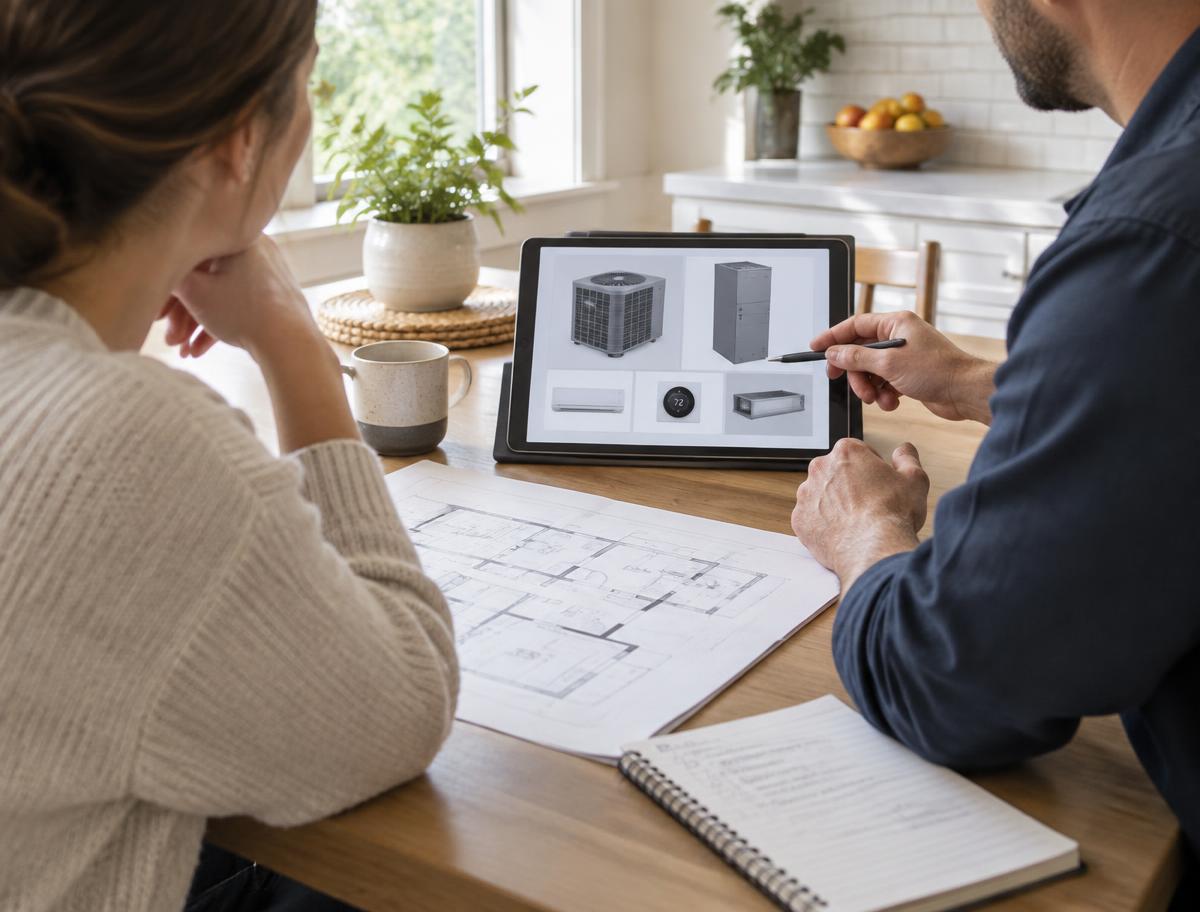

Have ducts? A central heat pump is worth a closer look.
Central heat pumps can serve multiple rooms through a duct network. The first step is checking whether that network and the proposed equipment can work together.
Heating + cooling
One configuration can cover both seasons.
A whole-home approach
Plan supply and return airflow across the rooms you use.
A winter plan
Review rated heating capacity and any supplementary heat.
Your ducts connect the system to your rooms
The outdoor unit works with indoor equipment to heat or cool air. Supply ducts deliver it to rooms; return paths bring air back. A useful recommendation considers those routes alongside the outdoor unit.
Simplified illustration, not an installation design. Closed rooms need a coverage discussion.
Central heating and cooling distribution
Supply ducts
Carry conditioned air towards rooms.
Return paths
Bring air back to the indoor system.
Simplified illustration, not an installation design.
What can stay from your current system?
Ducts and returns
Discuss weak airflow, noisy outlets and rooms that feel different when doors are closed.
Indoor equipment
Confirm which components are compatible and which need replacement or new connections.
Controls and electrical supply
Include required wiring, controls and other connection work in the proposal.
Three ways the upgrade could take shape
| Approach | When to explore it | Decision to resolve |
|---|---|---|
| Central replacement | You want heating and cooling through suitable ducts. | Which indoor components and connections change? |
| Compatible supplementary heating | Existing heating may form part of the winter plan. | How will the equipment and controls work together? |
| Targeted ductless zones | Selected rooms are the priority or ducts are unsuitable. | Which spaces will each indoor unit serve? |
Choose for winter comfort as well as summer cooling
A heat pump’s lowest operating temperature tells only part of the story. Compare the heat it can deliver in colder conditions with your home’s heating demand, then agree how any supplementary heat will work.
A heating plan for the whole season
Milder days
The heat pump responds to a lower heating demand.
Colder days
Compare the model’s available heat with the home’s demand.
Backup plan
Confirm any supplementary heat and how it is controlled.
A decision sequence, not a performance chart. Capacity varies by model and conditions.
Picture the installation before you agree it
Indoor connections
Review equipment position, duct transitions and practical access.
Outdoor position
Discuss required clearances, snow, drainage and access for future attention.
Related work
Identify electrical and control changes, and who handles anything excluded from the installation.
From your first question to installation
- 1
Talk through the home
Tell us your current heating, the rooms you use and what you want to improve.
- 2
Compare the options
A free visit brings equipment, room layout, the electrical panel and possible unit locations into the discussion.
- 3
Review the proposal
See the equipment, work, price and exclusions in writing. Ask for equipment warranty and installation labour terms.
- 4
Agree the installation
If you decide to proceed, confirm paperwork, payment or approved financing and a schedule directly with AirCrest.
- 5
Stay in touch
AirCrest follows up after installation. Keep your proposal and equipment details for future questions.
What changes the installed price?
The total depends on the equipment combination and the work needed to connect it to your home. Duct transitions, electrical requirements, controls and removal can make two central-system quotes quite different.
The system and rooms
Exact configuration, capacity and the rooms or zones the proposal is intended to serve.
The work around it
Connections, controls, electrical or duct work, removal and finishes where included. List excluded work separately.
The coverage afterwards
Written equipment warranty and installation labour terms, including exclusions and any registration requirements.
The purchase and payment
Total purchase price and payment arrangements. Read any financing offer as a separate agreement.
Central heat-pump FAQs
Service area & support
Serving PEI; Moncton, Saint John, Fredericton and Miramichi in New Brunswick; and Amherst and Springhill in Nova Scotia.
Ask about financing options for your project. Rebate eligibility is decided by the program administrator; verify requirements before purchase.
See whether central heating and cooling fits your home.
Start with a free home assessment and compare practical options before choosing equipment.
The online assessment is preview-only. No request is sent or appointment booked.